ABOUT SOCIAL PANORAMA
The Social Panorama model is a social psychological instrument with which you can change someones unconscious map of relational reality. Without being aware of it, you have fixed your position in society in your social panorama. This means that you always continue to be who you are, even if you want it to be different. In this model, interpersonal relationships are explained as cognitive constructions in mental space; we project people onto a mental location, and that location determines the quality of the relationship. Problems with intimate relationships, self confidence, conflicts, power, families, teams, and organizations can be relatively easily analyzed and solved with the help of the Social Panorama model.
This program includes the application of the Social Panorama model in coaching and therapy and its use in management and politics.


Who you are in society is largely the product of your own subconscious programming in the past. In this training course you have the chance to recreate yourself on the identity level: It will help you to adjust your position and role in society.
This 3 day training course on the application of the Social Panorama model is open to anyone who is a trained NLP practitioner or has an equivalent background. They will be able to use the principal methods for changing personifications and have sufficient insight into the psychological mechanisms involved.
A combination of demonstrations, exercises, and team work simulations provides a broad spectrum of learning opportunities.
CONTENTS
- Gathering reliable information about a client’s Social Panorama;
- Using the Social Panorama as a psycho-diagnostic tool (monitor function);
- Achieving lasting improvement in all types of social relationships;
- Using the Social Panorama for improving teams and social systems;
- Applications of the social panorama in education and training;
- Reinforcement of the experience of self;
- Achieving personality change using the family panorama, which encompasses a series of technical possibilities that, in particular, afford new approaches in psychotherapy;
- The family panorama with resources and a helper spirit;
- Identity change pattern;
- Identity design method;
- Simulations to apply the model in teams and groups;
- Ingroup-outgroup problems and their solution: mix;
- Political communication;
- Hierarchical relationships, power and dominance in the social panorama;
- Changing very negative relationships;
- The connection with family constellation work;
- The use of the social panorama for the exploration and harmonization of relationships with the dead, spirits and gods. The anthropological side of the model
METHODS
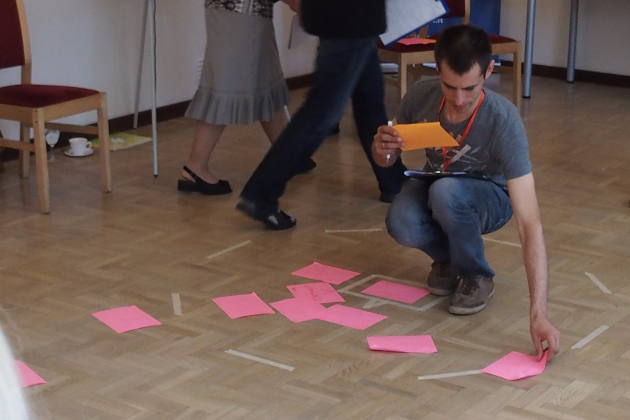
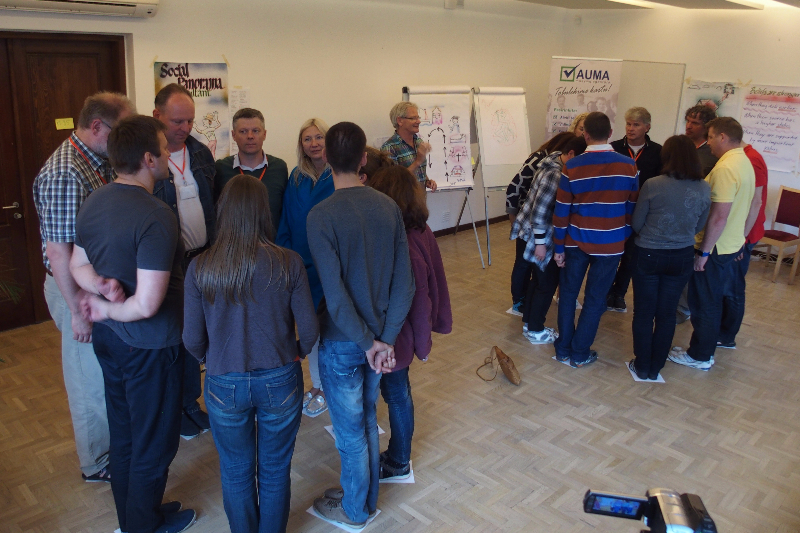
The course will include a great deal of structured and supervised practice. Demonstrations and exercises will be interwoven with group dynamic simulations. The criteria for certification are a report on the application of the family panorama method with a person from outside the course, together with a demonstration of practical ability and eighty percent attendance. During the exercises there will be plenty of opportunity for feedback.


WHO IS LUCAS DERKS?

Psychotherapist, social psychologist, artist, musician, author and described by Andrew T. Austin as, "The cleverest man I have ever met". Most widely known for his work in Social Panoramas, Lucas Derks was born on November 19, 1950 and lives in Holland. From 1973 up to 1976 he was teaching drawing and painting at the `De Werkschuit' Zeist/Bilthoven. He followed a dedactical training. From the age of ten onward his talent in the visual arts had been the guiding line. He was mainly painting in oil and tempera: solo exposition in 1980 and 1983.
Psychotherapist, social psychologist, artist, musician, author and described by Andrew T. Austin as, "The cleverest man I have ever met". Most widely known for his work in Social Panoramas, Lucas Derks was born on November 19, 1950 and lives in Holland. From 1973 up to 1976 he was teaching drawing and painting at the `De Werkschuit' Zeist/Bilthoven. He followed a dedactical training. From the age of ten onward his talent in the visual arts had been the guiding line. He was mainly painting in oil and tempera: solo exposition in 1980 and 1983.
From approximately 1970 onward he developed a strong interest in psychology and started a full time study social psychology in 1976; completing his masters degree 1982. Spending six months in Africa during his university years he completed his thesis on pragmatism. He became acquainted with the work of Bandler and Grinder (NLP) in March 1977.
He followed this in 1983 a NLP practitioner's training with the New York Training Institute for NLP; 1985 NLP masters training at the Institute for Eclectic Psychology in Nijmegen Holland.
In 1986 he choose to devote himself exclusively to NLP and related things.
Lucas wrote seven psychology books. He teamed up with the Dutch NLP trainers Jaap Hollander and Anneke Durlinger.
Ever since he has been doing free-lance jobs as a trainer at the Stichting voor Educatieve en Therapeutische Hypnose; SON Opleidingen BV te Eindhoven; Instituut voor Eclectische Psychologie and many other places in the Netherlands, Belgium, France, Germany, Hungaria, Finland, Suriname, Serbia, Brazil, England, New Zealand, Poland, Greece, Croatia, Malta and Austria.
From 1993 on, he became involved in the develeopement of new methods in the field of social systems: The Social Panorama. The connection between the pragmatic field of NLP with social psychology has become his mayor activity over the last decade.
Lucas Derks has two main websites, The International Laboratory For Mental Space Research and Social Panoramas.
IMPORTANT INFORMATION
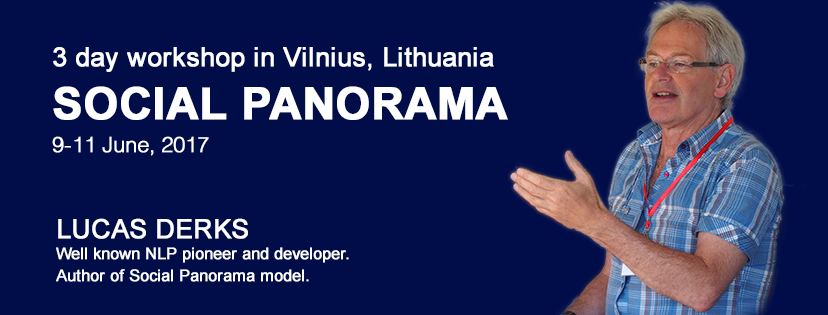
The course includes 24 hours of training and time to be held in the range of 10:00-18:00 over 3 days (9 to 11 June, 2017).
Also to cover all subjects and to avoid confusion and distortion or alteration message trainer course will be held in English, but with ongoing support language, the English-Lithuanian.
Participants will be issued a certificate of attendance.
INVESTMENT
Price for one person - 352 EUR*
* The price includes: lunch, coffee breaks and course materials.
* The number of places is limited.
PLACE AND TIME
Seminar date: 9-11 June, 2017.
Seminar place: "e-Loft Hotel", T. Ševčenkos g. 16F, Vilnius, Lithuania.
REGISTRATION
ORGANIZER:


